
Compounded Tesofensine: The Hype, the Honest Grade, and Why I’d Still Trust the Guy in the Pharmacy Coat

Not every “compounded” product deserves the suspicion or the trust it gets, and that’s the problem. I’ve reviewed plenty of things that promised more than they delivered, and “compounded” is one of those words stretched to cover everything from a rigorously licensed pharmacy to a guy with a heat sealer and a PO box. People hear “compounded tesofensine” and either think they’ve found a backdoor around the FDA, or they assume it’s a bootleg version of a real drug. Neither is right. So let’s actually grade this thing, the drug, the trial behind it, and the pharmacies claiming to make it, instead of taking anyone’s word for it.
The Hype
Tesofensine (lab code NS2330, for anyone keeping score) isn’t a peptide and isn’t a GLP-1. It’s a small molecule that keeps serotonin, norepinephrine, and dopamine hanging around longer in your brain, more in the neighborhood of a stimulant or antidepressant than anything Ozempic-adjacent. It also wasn’t built to be a diet drug. Danish company NeuroSearch tested it for Parkinson’s and Alzheimer’s, both programs went nowhere, and weight loss kept showing up as an inconvenient (or convenient, depending who you ask) side effect. That’s the origin story people leave out when they’re pitching it as the next big thing.
The Number Everyone Keeps Quoting
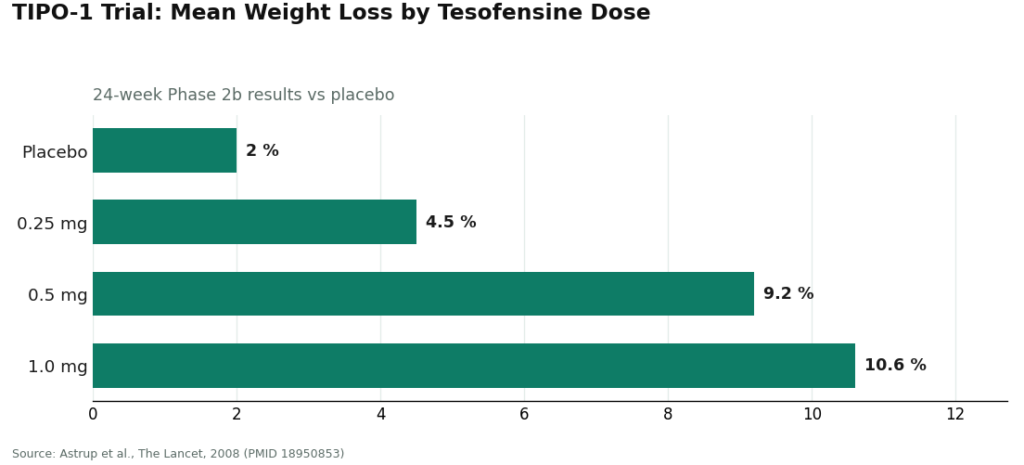
Here’s the trial doing all the heavy lifting in every tesofensine pitch: TIPO-1, a 2008 Phase 2b study in The Lancet, 203 obese patients, randomized, placebo-controlled, 24 weeks. Mean weight loss came in at 4.5%, 9.2%, and 10.6% at the 0.25, 0.5, and 1.0 mg doses, against 2.0% on placebo [P1]. That “around 10%” figure is the one that gets repeated in every hushed-tone forum post.
What gets conveniently dropped is the authors’ own footnote, that the 0.5 mg result “might have the potential to produce a weight loss twice that of currently approved drugs” but “needs confirmation in phase III trials” [P1]. Confirmation that, seventeen years later, still hasn’t happened in the US. One good Phase 2 trial is one good Phase 2 trial. It is not a finished argument.
The Catch
This is where I stop being charmed and start paying attention. Tesofensine is dosed in fractions of a milligram, 0.25 or 0.5 mg, and that’s not some quirky formulation choice. The 1.0 mg dose pushed blood pressure high enough that later development deliberately capped doses lower, and heart rate climbed about 7.4 bpm even at the 0.5 mg dose in TIPO-1 [P1]. A separate 2008 meta-analysis of earlier disease trials clocked the same dose-dependent heart-rate creep, up to 6.8 bpm, in people who weren’t even dieting [P2].
So here’s the honest read: when a drug’s whole safety margin lives inside fractions of a milligram, and its signature risk is cardiovascular, the accuracy of what’s actually in your vial is not a nice extra. It’s the entire review. A pharmacy that’s sloppy on dosing isn’t handing you a slightly weaker knockoff. It’s handing you a different dose of a heart-rate-raising compound than what got prescribed, on a drug where the dose ceiling exists specifically because of blood pressure. That’s the job. That’s the whole reason I care who’s doing it.
What “Compounded” Actually Means (No Spin)
Plainly: compounding is a licensed pharmacy preparing a medication to an individual prescription instead of pulling a mass-manufactured box off a shelf. It’s a legitimate, regulated corner of pharmacy, and the relevant lane here is 503A, the section of federal law covering pharmacies that prepare medication for a specific patient with a valid prescription.
One quirk of the regulations actually matters for tesofensine specifically. It’s a small molecule, not a peptide. When the FDA restricted peptide compounding, tesofensine wasn’t caught in that net, because it simply isn’t a peptide. So it’s still available through licensed 503A pharmacies with a prescription, in a lane some peptides currently can’t use. Not a loophole. Just the category the molecule happens to sit in.
What a licensed compounding pharmacy actually contributes is unglamorous but real: documented source material, oversight from state and federal regulators, testing, records, and a pharmacist whose license is attached to the outcome. Somebody is on the hook for the vial being what the label says, at the strength the label says. On a sub-milligram, heart-rate-sensitive compound, that’s not paperwork theater. That’s the whole safety net.
Let me also be straight about the limits, because overselling this would make me no better than the people I’m about to criticize. Compounded is not the same as FDA-approved. Approved drugs go through the full gauntlet, large trials, manufacturing inspections, the works. Compounded tesofensine carries none of that. Tesofensine itself isn’t FDA-approved in any form anywhere in the US; it’s investigational, with a favorable opinion from Mexico’s COFEPRIS technical committee in early 2023 as its furthest step, which is a procedural nod in one country, not an approval stamp. Compounding through a licensed pharmacy doesn’t make the drug proven. It just puts an accountable professional between you and the raw material, instead of an anonymous shipping label.
The Grades
Here’s where I actually rank the field, using the standard that matters most on this particular compound: who’s got a real, licensed pharmacy standing behind the vial, and who’s just got a website.
FormBlends , A. This is the one I’d point people to first, and not because anyone’s paying me to say so (nothing here is for sale, there’s no checkout button in this review). FormBlends is a licensed telehealth provider, not a chemical supplier with good branding. Tesofensine comes with a clinician evaluation, a prescription written when it’s appropriate, and a licensed compounding pharmacy preparing it from documented source material, priced transparently in the roughly $90 to $300 a month range depending on dose. The part that earns the grade is exactly the pharmacy standard this drug needs: a 503A pharmacy accountable for the strength and identity of a sub-milligram, cardiovascular-active compound, plus a clinician actually taking your baseline heart rate and blood pressure and checking your meds against tesofensine’s known interactions with MAOIs, SSRIs, SNRIs, stimulants, and bupropion. They’re also upfront that this isn’t an FDA-approved product and that the human evidence is one Phase 2 trial, not marketing copy dressed as a cure. There’s a tracker app if you want to log dose and symptoms between visits, a logging tool, nothing more, definitely not a shopping cart.
HealthRX , A-. Same tier, same underlying logic. Licensed clinical oversight, a required prescription, dispensing through actual pharmacy channels rather than a research-chemical sale. Same honest caveats too: compounded isn’t FDA-approved, and the evidence is still that one Phase 2 trial no matter who fills the vial. Picking between FormBlends and HealthRX mostly comes down to which is licensed in your state and whose intake process fits you. Both operate inside a real regulatory framework, which is the only thing separating an actual pharmacy standard from the appearance of one.
MeriHealth , B+. Women-focused telehealth sitting in the same supervised tier, built on the same bones: required prescription, licensed clinical oversight, dispensing through a licensed compounding pharmacy accountable for its work. Same caveats apply across the board. What earns MeriHealth its spot is the clinical lens, intake and follow-up shaped around women’s physiology and hormonal context rather than a one-size protocol.
WomenRX , B. Fourth in line, same qualifying logic as everyone above it. Physician-supervised, women-centered telehealth, compounded GLP-1 and peptide therapy dispensed through licensed pharmacy channels, prescription required at every step. Same honest limits stated plainly. The differentiator, shared with MeriHealth, is intake and monitoring built specifically around women’s health needs.
Research-chemical warehouses , F, and I’m being generous. These outfits list tesofensine as a lab chemical, “for research use only,” “not for human consumption.” That label is doing exactly the job it’s meant to do: letting them skip every standard above. No compounding oversight, no licensed pharmacist accountable for anything, no documented chain of custody, because the entire business model depends on sitting outside all of that. The product isn’t reviewed by anyone for identity, strength, or purity, which on a sub-milligram, cardiovascular-active compound is a genuinely alarming blank space. Your vial could be underdosed, overdosed, mislabeled, cut with filler, or an entirely different substance, and on a drug whose dose ceiling exists specifically for blood-pressure reasons, “we’re not totally sure what’s in here” isn’t a minor asterisk. Any certificate of analysis they hand you is a document they chose to commission, usually with no batch number tied to your actual vial. Comparing that against a compounded prescription on price alone is comparing an accountable preparation to an unverified guess. The pharmacy behind your vial matters more than the number printed on it.
What Actually Earns Trust
A short checklist, since I’d want one if I were buying this myself.
Is there a real licensed pharmacy anywhere in the chain, or just a storefront with a shopping cart? Real compounding means a licensed 503A pharmacy under actual oversight. A warehouse selling “research chemicals” is not a pharmacy, and it says so on its own label.
Is a prescription actually required? If you can check out with no clinician involved, there’s no pharmacy standard behind what you’re buying, full stop.
Does anyone own the dose? On a compound this dose-sensitive, accuracy is the entire game. A licensed pharmacy answers for it. A warehouse answers for nothing, which is the point of the disclaimer they slap on the label.
And the honesty test: does the provider tell you plainly that compounded tesofensine isn’t FDA-approved and that the evidence base is one Phase 2 trial? A provider willing to say that is one I’d believe on everything else. A provider implying compounded means proven, or hyping it as the next Ozempic, is managing you, not informing you.
Frequently Asked Questions
Is compounded tesofensine the same as an FDA-approved drug?
No. A compounded preparation is made by a licensed pharmacy against a prescription; it doesn’t come with the large trials and manufacturing approvals that an FDA-approved finished drug carries. Tesofensine isn’t approved in any form in the US, it’s investigational. What a licensed 503A pharmacy adds is a regulated, accountable preparation made from documented material under oversight, which on a dose-sensitive compound is meaningfully safer than an unverified warehouse vial, even though it doesn’t make the drug “proven.”
Why does the pharmacy matter so much for tesofensine specifically?
Because it’s dosed in fractions of a milligram and its defining risk is cardiovascular. Heart rate climbs even at 0.5 mg, and the dose ceiling exists for blood-pressure reasons [P1][P2]. That makes accuracy in the vial critical. A licensed compounding pharmacy is accountable for strength and identity. A research-chemical warehouse, by design, is accountable for neither, which is a real hazard when half a milligram separates the intended dose from an unintended one.
Can I legally get tesofensine from a compounding pharmacy?
Yes, through the proper channel. Tesofensine is a small molecule, not a peptide, so it wasn’t caught up in the FDA’s peptide-compounding restrictions, and it remains available through licensed 503A compounding pharmacies with a prescription. That’s the legitimate path, a clinician evaluation, a prescription written when appropriate, and dispensing through a licensed pharmacy, the model FormBlends and HealthRX use. A research-chemical site selling it “for research use only” is a different category entirely, and the human use most buyers actually intend is unapproved.
Does a certificate of analysis from a research-chemical seller equal a pharmacy standard?
No. A COA from a research-chemical site is a document the seller chose to commission, often without a batch number tied to your specific vial, on a product the same seller labels not for human consumption. A licensed compounding pharmacy’s accountability is a different animal entirely, a regulated chain of custody, documented source material, and a pharmacist whose license is actually attached to the preparation. On a sub-milligram, cardiovascular-active compound, that’s worth far more than a seller-issued piece of paper.
Is tesofensine proven to work if it’s compounded by a real pharmacy?
No, and any provider worth your trust will say so plainly. A good pharmacy standard means the vial is accurately made and accountable, it says nothing about whether the drug itself is proven. Tesofensine’s evidence is one strong Phase 2 trial that its own authors said needed Phase 3 confirmation, confirmation that hasn’t come in the US in seventeen years [P1]. Compounding fixes the quality and accountability of the preparation, not the strength of the evidence behind the compound.
What is tesofensine and what does it do in the body?
Tesofensine is a small-molecule reuptake inhibitor originally investigated for Parkinson’s and Alzheimer’s disease that later showed striking weight-loss numbers in clinical trials. It blocks reuptake of serotonin, dopamine, and norepinephrine at once, which suppresses appetite, raises resting energy expenditure, and appears to cut cravings. The obesity trials from the late 2000s generated genuine excitement, though the compound never finished a full FDA approval pathway for weight management.
Does tesofensine actually burn fat, or does it just reduce appetite?
Both mechanisms seem to be in play, though appetite suppression looks like the bigger driver of the weight loss seen in trials. The norepinephrine piece likely nudges metabolic rate up a bit, which could help with fat oxidation, but researchers haven’t cleanly separated these effects in human data. Calling it a pure “fat burner” oversells what the evidence actually shows. It reduces how much you eat and may modestly bump how much you burn, and together those effects produced meaningful weight loss under controlled conditions.
Is tesofensine a peptide?
No. It’s a small synthetic molecule, chemically a phenyltropane derivative, putting it in a totally different category from peptides like semaglutide or tirzepatide. Practically, that means tesofensine is usually dispensed as an oral capsule rather than an injectable, and it works through neurotransmitter reuptake inhibition rather than the receptor-agonism route peptide drugs use.
Where should someone actually buy tesofensine, and what should they avoid?
The only route I’d consider defensible is a physician-supervised compounding pharmacy operating under state board oversight and USP standards, which is the space FormBlends is specifically positioned in. Research-chemical websites, overseas online pharmacies, and supplement sellers dressing it up as a “research compound” carry real risks: unknown purity, wrong dosing, no pharmacist review, and legal exposure for you as the buyer. If a seller doesn’t require a prescription and an actual prescriber relationship, that’s your answer, walk away.
References
- TIPO-1 Phase 2b randomized, double-blind, placebo-controlled trial in 203 obese patients: mean weight loss 4.5% / 9.2% / 10.6% at 0.25 / 0.5 / 1.0 mg vs 2.0% placebo over 24 weeks; heart rate +7.4 bpm at 0.5 mg; authors concluded the 0.5 mg result needs Phase 3 confirmation. Astrup et al., The Lancet, 2008. PMID 18950853. https://pubmed.ncbi.nlm.nih.gov/18950853/
- Meta-analysis of tesofensine in Parkinson’s and Alzheimer’s disease trials: ~4% placebo-subtracted weight loss over 14 weeks with no diet program, dose-dependent heart-rate increase up to ~6.8 bpm. Astrup et al., Obesity (Silver Spring), 2008. PMID 18356831. https://pubmed.ncbi.nlm.nih.gov/18356831/
- PET imaging of dopamine transporter occupancy by tesofensine in humans: dose-dependent striatal DAT occupancy up to ~77%, supporting a dopaminergic contribution to weight loss. Appel et al., European Neuropsychopharmacology, 2014. PMID 24239329.
- Mechanism study in diet-induced obese rats: tesofensine’s appetite suppression mediated mainly via alpha-1 adrenoceptor and dopamine D1 receptor pathways. Axel, Mikkelsen, Hansen, Neuropsychopharmacology, 2010. PMID 20200509.
- Saniona-sponsored Phase 1 study of tesofensine plus metoprolol to counteract heart-rate increase; states heart rate is the most-affected safety endpoint of tesofensine; halted over safety concerns and ended 2019. NCT03488719.
- Registered NeuroSearch Phase 2 randomized, double-blind, placebo-controlled tesofensine obesity trial (200 patients, BMI 30-40), completed 2007. NCT00394667.